
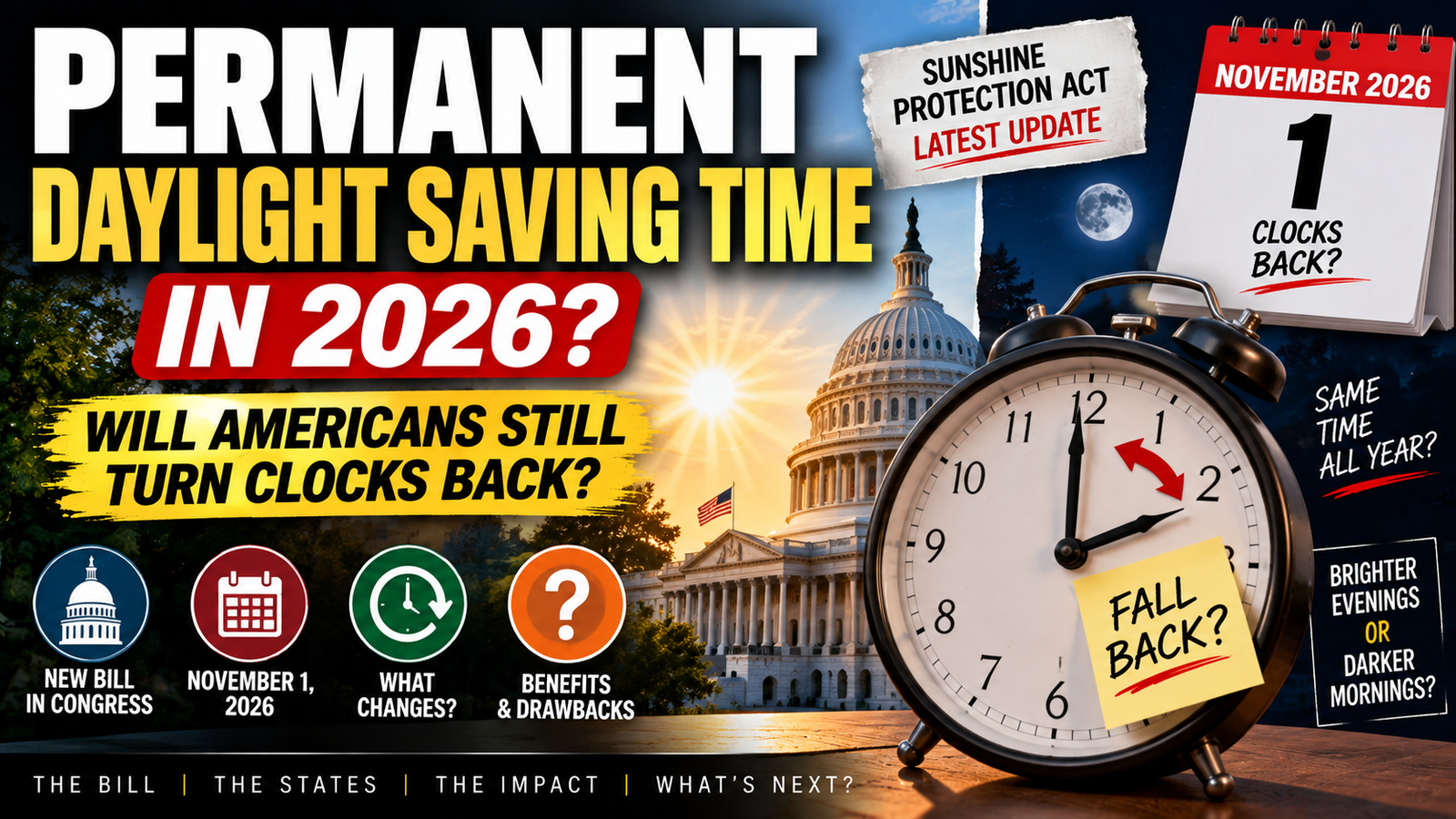

Permanent Daylight Saving Time is back at the center of the U.S. time-change debate in 2026. A bill in Congress, the Sunshine Protection Act of 2025 (H.R. 139), would make daylight saving time the year-round clock setting across most of the United States and eliminate the twice-yearly practice of changing clocks.
The House of Representatives passed the bill on July 14, 2026, but it has not become law. The measure was received in the Senate and referred to the Senate Committee on Commerce, Science, and Transportation on July 15.
That means Americans should not assume that the November 2026 clock change has been canceled. Under the current federal rules, daylight saving time ends at 2 a.m. on November 1, 2026, when clocks in participating states are scheduled to move back one hour.
What Is Permanent Daylight Saving Time?
Permanent daylight saving time means the U.S. would remain on its summer clock setting throughout the entire year.
Under the current system, most of the U.S. changes clocks twice annually:
- March: Clocks move forward one hour.
- November: Clocks move backward one hour.
With permanent DST, there would be no November “fall back” and no following March “spring forward.”
The important distinction is that permanent DST is not the same thing as permanent standard time.
Permanent DST vs. Permanent Standard Time
| System | What happens? |
|---|---|
| Current system | DST in spring/summer, standard time in fall/winter |
| Permanent DST | DST all year |
| Permanent standard time | Standard time all year |
| Current H.R. 139 proposal | Permanent DST for most states, while allowing existing permanent-standard-time states/areas to continue standard time |
The current federal Uniform Time Act permits states to opt out of daylight saving time, but an opting-out state must remain on standard time. Federal law currently does not permit a state to independently choose daylight saving time throughout the entire year.
What Is the Sunshine Protection Act?
The Sunshine Protection Act is legislation intended to make daylight saving time permanent.
The current House-passed version is H.R. 139, officially titled the Sunshine Protection Act of 2025.
The bill’s stated purpose is to make daylight saving time permanent and eliminate the twice-yearly clock change.
The House passed the measure on July 14, 2026.
The bill then moved to the Senate, where it was received and referred to the Senate Commerce Committee on July 15, 2026.
Is Permanent Daylight Saving Time Law Yet?
No.
This is the most important point for the 2026 debate.
Although the House has passed H.R. 139, the bill still needs to complete the legislative process before it can become federal law.
As of September 22, 2026, the bill has not been enacted.
Therefore, the existing federal time-change rules remain in effect.
Will We Turn the Clocks Back in November 2026?
Under the law currently in effect, yes.
The National Institute of Standards and Technology says daylight saving time in 2026 runs from March 8 through November 1. At 2 a.m. on November 1, clocks are scheduled to move back one hour in states that observe DST.
The situation could change if Congress passes the legislation and it is signed into law before the relevant date.
But until that happens, the normal November clock change remains scheduled.
When Could Permanent Daylight Saving Time Start?
There is currently no confirmed start date for nationwide permanent daylight saving time because H.R. 139 has not yet become law.
The actual implementation date would depend on the final legislation enacted by Congress.
Therefore, claims that the U.S. has definitely switched to permanent DST in 2026 are premature.
Why Does the U.S. Change Clocks?
The modern federal daylight-saving system is based on the Uniform Time Act of 1966, with later changes extending the annual DST period.
The current schedule was expanded under the Energy Policy Act of 2005.
Today, DST begins on the second Sunday in March and ends on the first Sunday in November.
The original arguments around daylight saving time included energy use and making better use of daylight during the evening.
Over the years, however, the debate has expanded to include:
- Public safety
- Sleep
- Health
- Transportation
- Retail
- School schedules
- Work schedules
- Recreation
- Energy consumption
- Economic activity
What Would Permanent Daylight Saving Time Change?
The biggest everyday change would be the timing of sunrise and sunset.
During the winter, the clock would remain one hour ahead of standard time.
That means people in many locations would experience later sunrises and later sunsets compared with the current winter schedule.
For example, a winter sunrise that currently occurs around 7 a.m. under standard time could occur around 8 a.m. under permanent DST.
The exact difference depends on location and date.
The Main Effect
Permanent DST does not create more sunlight.
It simply changes what time the clock says when the sunlight occurs.
The same amount of daylight would exist; the clock would label the daylight hours differently.
Potential Advantages of Permanent Daylight Saving Time
Supporters of permanent DST have emphasized several potential advantages.
1. No More Clock Changes
People would no longer need to adjust clocks twice a year.
That could simplify:
- Travel
- Work schedules
- School schedules
- Meetings
- Transportation
- Electronic systems
- Business operations
2. More Evening Daylight
Compared with permanent standard time, permanent DST would produce later sunsets.
This could provide more daylight after the traditional work or school day.
Outdoor activities could therefore take place later in the evening.
3. Consistency
A year-round clock setting would eliminate the recurring adjustment between DST and standard time.
Supporters argue that a single time setting could make scheduling easier.
4. Recreation
Later sunsets can provide additional daylight for:
- Sports
- Walking
- Cycling
- Shopping
- Restaurants
- Outdoor entertainment
- Family activities
However, whether these benefits outweigh other effects depends on location and individual circumstances.
Potential Disadvantages of Permanent Daylight Saving Time
There are also concerns about permanent DST.
1. Darker Winter Mornings
This is one of the most frequently discussed issues.
Because the clock would remain one hour ahead during winter, sunrise would occur later by the clock.
In northern states, winter mornings could therefore remain dark well into the morning commute or school day.
2. Sleep Concerns
Sleep researchers and medical organizations have raised concerns about permanent DST.
The American Academy of Sleep Medicine has historically supported permanent standard time rather than permanent daylight saving time, arguing that standard time better aligns with human circadian biology.
The debate therefore involves not simply whether clocks should change, but which clock setting should become permanent.
3. Schoolchildren
Later winter sunrises could mean some students would travel to school before sunrise.
This is especially relevant in northern parts of the country where winter daylight hours are already limited.
4. Geographic Differences
The United States covers a very large geographic area.
A time policy that produces relatively comfortable sunrise and sunset schedules in one state can produce very different results in another.
For example, northern states experience much larger seasonal changes in daylight than states closer to the equator.
Permanent Daylight Saving Time vs. Permanent Standard Time
This is an important part of the debate.
Some lawmakers and researchers have argued that the U.S. should stop changing clocks by adopting permanent standard time instead.
Under permanent standard time:
- Winter mornings would remain closer to current schedules.
- Winter sunsets would occur earlier than under permanent DST.
- There would still be no twice-yearly clock change.
Under permanent DST:
- Winter sunrises would be later.
- Winter sunsets would be later.
- There would also be no clock changes.
So the fundamental question is not simply:
“Should we stop changing clocks?”
It is also:
“Which time should we keep?”
Which States Already Have Laws Supporting Permanent DST?
Several states have enacted laws expressing an intention to adopt year-round daylight saving time if federal law permits it.
The National Conference of State Legislatures reported that 19 states had enacted such legislation in recent years, including:
- Alabama
- Colorado
- Delaware
- Florida
- Georgia
- Idaho
- Louisiana
- Maine
- Minnesota
- Mississippi
- Montana
- Oklahoma
- Oregon
- South Carolina
- Tennessee
- Texas
- Utah
- Washington
- Wyoming
These state laws generally depend on Congress changing federal law before permanent DST can take effect.
What About Florida?
Florida was the first state to enact legislation calling for permanent daylight saving time, doing so in 2018.
However, the state’s law depends on federal authorization because current federal law does not allow states to independently observe DST throughout the entire year.
What About Texas?
Texas enacted legislation in 2025 that would establish year-round daylight saving time under certain conditions.
But Texas cannot simply implement permanent DST under current federal law.
The federal authorization remains an important prerequisite.
Arizona and Hawaii
Two states already largely avoid the traditional DST cycle.
Arizona
Most of Arizona does not observe daylight saving time.
The Navajo Nation is an exception and observes DST.
Hawaii
Hawaii also does not observe daylight saving time.
As a result, residents of these states generally do not participate in the twice-yearly clock changes experienced by most Americans.
What Happens if Congress Does Nothing?
If Congress does not change the law, the existing schedule continues.
For 2026, that means:
March 8, 2026: DST began.
November 1, 2026: DST is scheduled to end.
The same general March-November system would continue in future years under current law.
Does Permanent DST Mean More Daylight?
No.
This is a common misunderstanding.
Permanent DST does not create additional sunlight.
The Earth will continue to rotate exactly as before.
Instead, permanent DST changes the relationship between the clock and the daylight.
For example, if sunrise occurs at 7 a.m. under standard time, it could occur at approximately 8 a.m. under DST.
The sunlight has not changed—the clock has.
Why Is Permanent Daylight Saving Time Trending Again in 2026?
The issue returned to national attention because the House passed H.R. 139 in July 2026.
The House vote represented a significant step toward changing the federal time system, but the Senate still needs to act before the legislation can become law.
The debate also remains divided between people who favor permanent DST and those who prefer permanent standard time.
Could the U.S. Stop Changing Clocks in 2026?
It is possible but not guaranteed.
As of September 22, 2026:
- The House has passed H.R. 139.
- The Senate has received the bill.
- The bill has been referred to the Senate Commerce Committee.
- The bill has not become law.
- November 1 remains the scheduled end of DST under current law.
Therefore, the November clock change should still be expected unless federal law changes before then.
Permanent Daylight Saving Time in Simple Terms
Imagine the current system as:
Summer: Clock = normal time + 1 hour
Winter: Clock = normal time
Permanent DST would mean:
Summer: Clock = normal time + 1 hour
Winter: Clock = normal time + 1 hour
There would be no November adjustment and no March adjustment.
Permanent DST and India
India does not currently observe daylight saving time.
India uses Indian Standard Time (IST) throughout the year.
Therefore, the U.S. debate over permanent DST does not directly change India’s clocks.
However, if the U.S. changes its clock system, the time difference between India and the United States can change seasonally or become different from what people currently expect, depending on the U.S. state and whether it observes DST.
What Would Permanent DST Mean for India-U.S. Time Differences?
This can matter for:
- IT companies
- Remote workers
- Online meetings
- Customer-support teams
- Students
- International businesses
- Stock-market watchers
- Content creators
Because India stays on IST year-round, a U.S. move to permanent DST would affect the seasonal time difference between India and participating U.S. time zones.
The exact difference depends on the U.S. location.
Permanent Daylight Saving Time FAQ
Is daylight saving time becoming permanent in 2026?
Not yet. The House passed H.R. 139, but the bill still requires further congressional action before becoming law.
Will clocks fall back in November 2026?
Under the law currently in effect, yes. The scheduled date is November 1, 2026.
What is the Sunshine Protection Act?
It is legislation designed to make daylight saving time permanent and eliminate the twice-yearly clock change.
Did the House pass permanent daylight saving time?
Yes. The House passed H.R. 139 on July 14, 2026.
Has the Senate passed it?
As of September 22, 2026, the bill has been referred to the Senate Commerce Committee and has not become law.
Will permanent DST make the days longer?
No. It changes the clock, not the amount of daylight.
What is the difference between permanent DST and permanent standard time?
Permanent DST keeps the summer clock setting year-round. Permanent standard time keeps the winter clock setting year-round.
Which states do not observe daylight saving time?
Most of Arizona and Hawaii do not observe DST. Several U.S. territories also remain on standard time.
Does India use daylight saving time?
No. India observes IST year-round.
When does daylight saving time end in 2026?
Under current federal rules, DST ends at 2 a.m. on November 1, 2026.
Final Takeaway
The United States is closer to changing its daylight-saving rules than it has been in several years, but permanent daylight saving time is not yet federal law.
The House passed the Sunshine Protection Act in July 2026, but the legislation remains pending in the Senate. Until Congress changes the law and the measure takes effect, the existing system remains in place.
For now, most Americans should continue to expect the clock to fall back one hour on November 1, 2026.
The larger debate remains whether the U.S. should adopt permanent daylight saving time, permanent standard time, or retain the current seasonal system. Each option changes the timing of sunrise and sunset differently, and the effects vary considerably by location and season.