
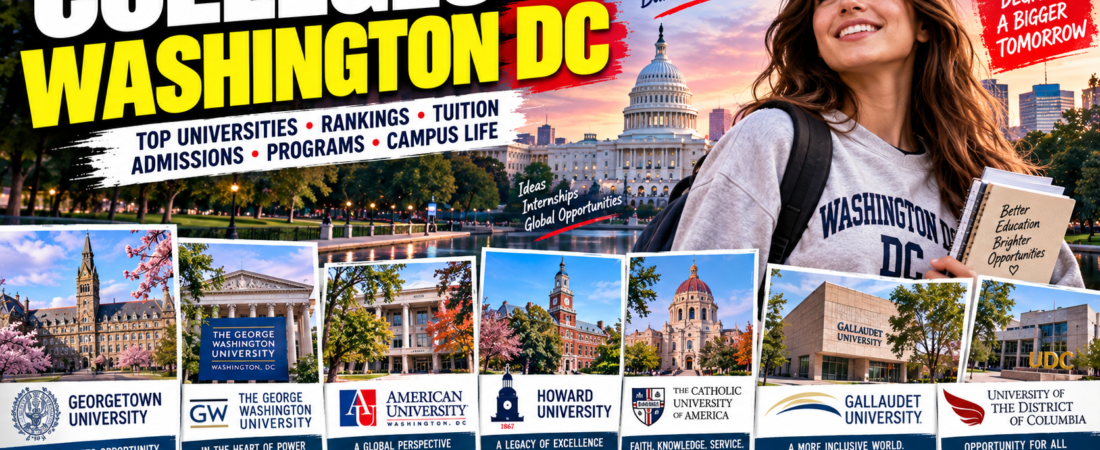
Washington, D.C. is much more than the political capital of the United States. It is also one of the country’s most interesting college cities, with universities ranging from internationally recognized private institutions to historically Black universities, specialized schools and the city’s public university.
For students, one of the biggest advantages of studying in Washington, D.C. is the environment outside the classroom. The city is home to the U.S. government, embassies, nonprofit organizations, museums, media companies, international institutions, law firms, think tanks and thousands of other organizations.
That means a college student in Washington can potentially combine classroom education with internships, research, networking and professional experience during the academic year.
There are several well-known colleges and universities in Washington, D.C., including Georgetown University, George Washington University, American University, Howard University, Catholic University of America, Gallaudet University, Trinity Washington University and the University of the District of Columbia. The District’s 2026 higher-education listings also include several specialized institutions.
This guide looks at the major colleges in Washington, D.C. in detail, including rankings, academic strengths, tuition considerations, admissions, campus life and what makes each institution different.
Why Study in Washington, DC?
Before comparing individual universities, it is worth understanding what makes Washington such a popular college destination.
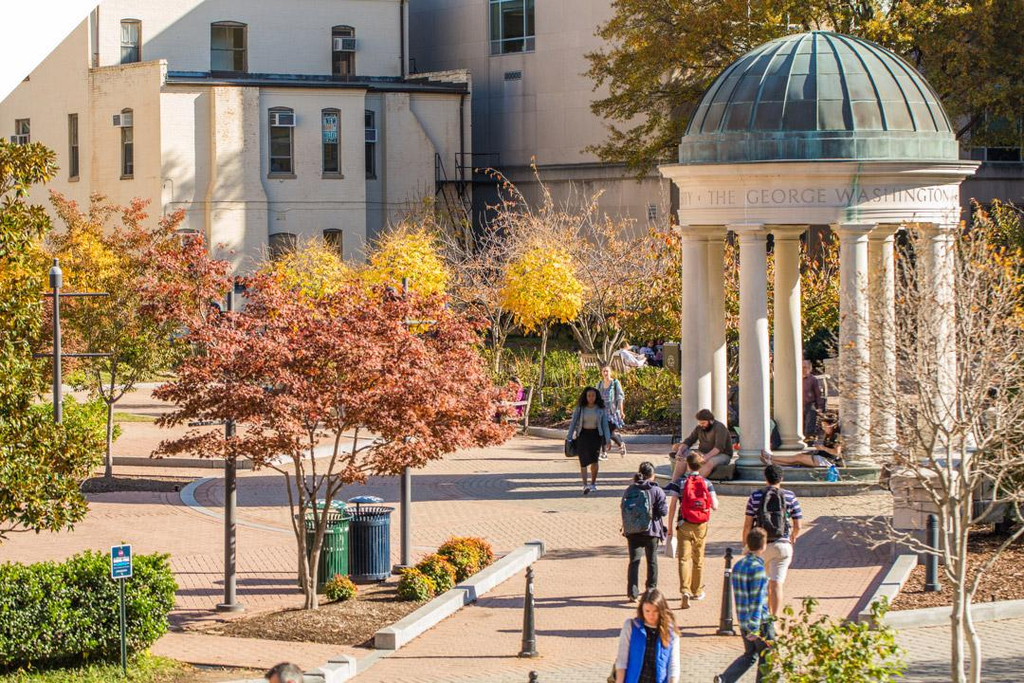
Unlike a traditional college town, Washington, D.C. has a professional environment that operates alongside its university campuses.
A student can attend class in the morning and potentially spend the afternoon at an internship, research organization, government agency, nonprofit or media organization.
This is particularly relevant for students studying:
- Political science
- International relations
- Public policy
- Government
- Journalism
- Communications
- Law
- Economics
- Business
- Public health
- International development
- History
- Public administration
- Security studies
- Diplomacy
The city is also home to the Smithsonian Institution, Library of Congress, Supreme Court, Capitol Hill, federal agencies, foreign embassies and numerous cultural institutions.
That combination makes Washington particularly attractive to students who want their university experience to include professional exposure.
Best Colleges in Washington, DC
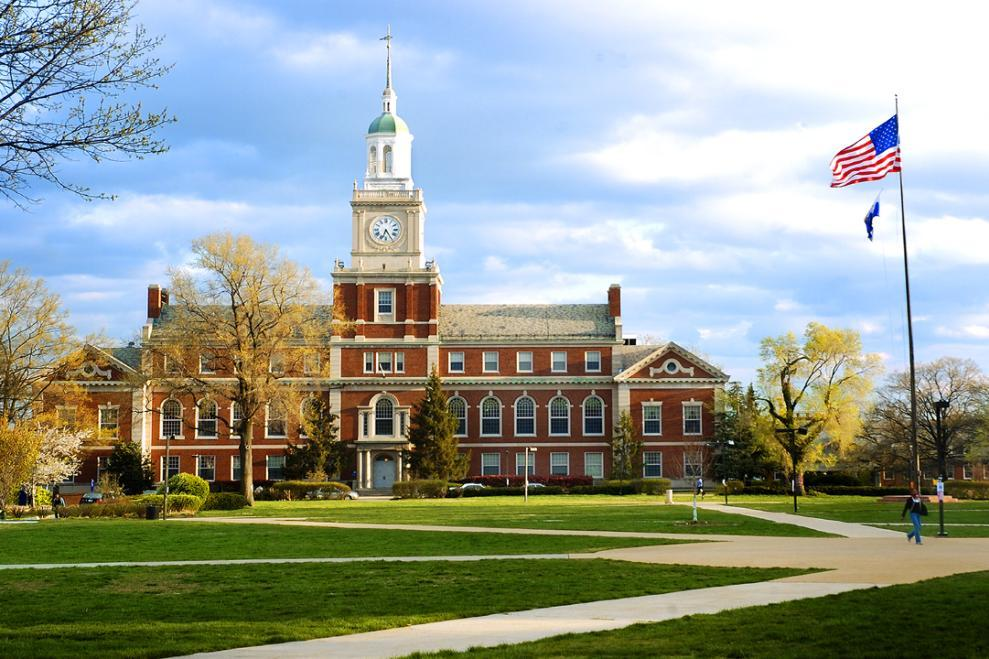
There isn’t one universally accepted ranking of Washington, D.C. colleges.
Different ranking organizations use different methodologies.
For example, one 2026 District of Columbia ranking based on research output and academic influence places Georgetown first, George Washington second, American third and Howard fourth. Another data-based college guide using College Scorecard and IPEDS data presents schools according to graduate earnings, tuition and graduation rates rather than an editorial ranking.
For that reason, the following list is best understood as a guide to the major and notable universities in Washington, D.C., rather than a single definitive “best college” list.
Major Washington, DC Colleges
| College | Type | Location | Known for |
|---|---|---|---|
| Georgetown University | Private | Washington, DC | International relations, business, law, politics |
| George Washington University | Private | Washington, DC | International affairs, business, medicine, public policy |
| American University | Private | Washington, DC | International relations, public affairs, communications |
| Howard University | Private HBCU | Washington, DC | STEM, business, medicine, law, arts |
| Catholic University of America | Private | Washington, DC | Architecture, engineering, law, liberal arts |
| Gallaudet University | Private | Washington, DC | Deaf and hard-of-hearing education, liberal arts |
| Trinity Washington University | Private | Washington, DC | Education, nursing, business, liberal arts |
| University of the District of Columbia | Public | Washington, DC | Public higher education, professional programs |
1. Georgetown University
Georgetown University is one of the most recognizable universities in Washington, D.C.
Founded in 1789, Georgetown has a long history and is located in the historic Georgetown neighborhood.
Its location is one of its major attractions. Students are close to the federal government while also having access to the restaurants, shops and residential areas surrounding Georgetown.
Georgetown Academics
Georgetown is particularly well known for:
- International relations
- Political science
- Government
- Business
- Economics
- Law
- Public policy
- Foreign service
- Health-related programs
- Liberal arts
The Edmund A. Walsh School of Foreign Service is especially well known among students interested in international affairs and diplomacy.
The university also operates the McDonough School of Business and Georgetown Law.
Georgetown Ranking
In the 2026 U.S. News rankings, Georgetown University was reported at #24 among national universities, according to WTOP’s coverage of the 2026 rankings.
A separate 2026 District of Columbia research-based ranking places Georgetown first among universities in the District.
These rankings measure different things, so students should not treat them as interchangeable.
Georgetown Student Experience
Georgetown has a traditional university environment while still being part of Washington.
The main campus is relatively close to the Potomac River and the Georgetown neighborhood.
Students can participate in:
- Student organizations
- NCAA athletics
- Research
- Internships
- Study abroad
- Community service
- Campus events
For students interested in international relations, government, business or law, Georgetown’s location can be particularly relevant.
2. George Washington University
George Washington University, usually called GW or GWU, has a very different campus experience from Georgetown.
GW’s main Foggy Bottom campus is located close to the White House, National Mall and many federal and international organizations.
That location puts students directly into the center of Washington.
George Washington University Academics
GW offers programs in areas including:
- International affairs
- Political science
- Public health
- Business
- Engineering
- Computer science
- Journalism
- Communications
- International development
- Medicine
- Law
- Economics
The Elliott School of International Affairs is particularly relevant for students interested in global affairs and international policy.
George Washington University Ranking
George Washington University was ranked #59 nationally in the 2026 U.S. News rankings, according to WTOP’s report on the rankings.
A 2026 District of Columbia research-based ranking placed GW second among universities in Washington, D.C.
What Makes GW Different?
One of the most distinctive features of GW is its urban campus.
Students are not isolated from the city.
Instead, Washington is effectively part of the campus environment.
The White House, National Mall, State Department and numerous other organizations are within the broader area surrounding the university.
For students who enjoy city life and want an urban college environment, this can be an important factor.
3. American University
American University is another major private university in Washington, D.C.
The university is located in Northwest Washington and has a strong identity around international affairs, public service, communication and policy.
American University was ranked #88 nationally in the 2026 U.S. News Best Colleges rankings. It also ranked #5 for study abroad and #15 for co-ops and internships in those rankings.
American University Programs
Some of AU’s notable academic areas include:
- International relations
- Political science
- Public affairs
- Communications
- Journalism
- Business
- Economics
- Environmental studies
- Public policy
- International development
The School of International Service is one of the university’s most recognizable schools.
The School of Public Affairs is another important part of AU’s academic profile.
American University Internships
Internships are a major part of the university’s Washington experience.
The university’s location gives students potential access to:
- Federal agencies
- Nonprofits
- Think tanks
- International organizations
- Media companies
- Policy organizations
- Advocacy groups
- Embassies
This is reflected in the university’s #15 U.S. News ranking for co-ops and internships.
American University Tuition
American University is a private university, so its published tuition is considerably higher than public in-state tuition at many American universities.
For 2026–27, AU lists undergraduate tuition at $62,680, while its estimated first-year on-campus cost of attendance is $87,374.
Students should therefore look carefully at scholarships and financial aid rather than comparing tuition alone.
4. Howard University
Howard University is one of the most historically significant universities in Washington, D.C.
It is a private, historically Black university, commonly known as an HBCU.
Howard has played an important role in American higher education and has educated generations of leaders in politics, business, science, medicine, law, entertainment and the arts.
Howard University Academics
Howard offers programs across a wide range of fields.
Popular and notable areas include:
- Business
- Biology
- Chemistry
- Engineering
- Computer science
- Medicine
- Nursing
- Pharmacy
- Law
- Communications
- Journalism
- Political science
- Fine arts
- Social sciences
Howard’s professional schools make it particularly significant for students interested in medicine, law, business and related careers.
Howard University Campus
Howard’s campus is located in Northwest Washington.
It offers a traditional college environment with residence halls, academic buildings, libraries, student organizations and athletic programs.
The university also has a strong cultural identity connected to its history as an HBCU.
Howard University Ranking
Howard was ranked second behind Spelman College in the U.S. News 2026 Top Historically Black Colleges and Universities category, according to WTOP’s report.
That HBCU-specific ranking should not be confused with a general national-university ranking.
For students specifically interested in HBCU education, however, this category can provide useful context.
5. The Catholic University of America
The Catholic University of America is another major university in Washington, D.C.
It is located in the Northeast section of the city near the Brookland neighborhood.
Catholic University combines undergraduate education with graduate and professional programs.
Catholic University Programs
The university is known for fields including:
- Architecture
- Engineering
- Business
- Psychology
- Nursing
- Philosophy
- Theology
- Social sciences
- Arts
- Law
- Education
Its location also places students close to the institutions and organizations that make Washington unique.
Campus Environment
Catholic University has a more traditional campus atmosphere than some of Washington’s highly urban universities.
Students can experience:
- Residence halls
- Campus organizations
- Athletics
- Libraries
- Research
- Religious activities
- Student events
This makes it an option for students who want a defined campus environment while still studying in Washington.
6. Gallaudet University
Gallaudet University is one of the most distinctive universities in Washington, D.C.
It has a historic mission centered on deaf and hard-of-hearing students and is widely known for its leadership in deaf education and related fields.
Gallaudet is located in Northeast Washington near the NoMa area.
What Makes Gallaudet Different?
Gallaudet is not simply another general university.
Its identity is closely connected to deaf culture, American Sign Language and accessibility.
The university offers programs in areas such as:
- Education
- Communication
- Psychology
- Government
- Business
- Information technology
- Social sciences
- Deaf studies
For students interested in accessibility, deaf education, communication or related subjects, Gallaudet provides a distinctive academic environment.
7. Trinity Washington University
Trinity Washington University is a private university located in Northeast Washington.
It has historically been associated with women’s education and today offers undergraduate and graduate programs.
The university’s academic offerings include areas such as:
- Business
- Education
- Nursing
- Psychology
- Communication
- Social sciences
- Professional studies
Trinity can be an option for students looking for a smaller university environment in Washington.
Its relatively small scale can provide a different experience from larger institutions such as GW or Howard.
8. University of the District of Columbia
The University of the District of Columbia, commonly known as UDC, is Washington, D.C.’s public university.
This makes it particularly important for students looking for a public higher-education option inside the District.
UDC also operates UDC Community College.
UDC Programs
The university offers programs in areas including:
- Business
- Computer science
- Engineering
- Nursing
- Education
- Architecture
- Public administration
- Social sciences
- Agriculture
- Health sciences
Because it is a public institution, cost can be an important consideration for eligible students.
UDC’s main campus is located at 4200 Connecticut Avenue NW.
Washington DC Colleges: Tuition Comparison
The cost of attending college in Washington can vary significantly.
Private universities generally have higher published tuition than public institutions, although financial aid can substantially change the amount a student actually pays.
A College Scorecard/IPEDS-based 2026 data compilation lists the following annual tuition figures:
| College | Reported tuition |
|---|---|
| Georgetown University | $65,081 |
| George Washington University | $64,990 |
| American University | $56,543 |
| Catholic University of America | $55,834 |
| Howard University | $33,344 |
| Trinity Washington University | $26,110 |
| Gallaudet University | $18,382 |
The figures above are presented by the source as tuition data and should not be confused with each university’s full cost of attendance.
Room, meals, transportation, books, health insurance and personal expenses can add thousands of dollars to the actual yearly cost.
Washington DC Colleges by Graduation Outcomes
College rankings become more useful when students look beyond reputation.
According to the College Scorecard/IPEDS-based 2026 data compilation, reported graduation rates include:
| College | Reported graduation rate |
|---|---|
| Georgetown University | 95% |
| George Washington University | 85% |
| American University | 79% |
| Catholic University of America | 79% |
| Howard University | 69% |
| Gallaudet University | 45% |
| Trinity Washington University | 42% |
The exact definition and cohort used for a graduation-rate statistic matters, so prospective students should check the underlying federal College Scorecard data when making financial or enrollment decisions.
Washington DC Colleges and Graduate Earnings
Another metric students sometimes investigate is earnings after college.
The College Scorecard/IPEDS-based data compilation reports median earnings five years after enrollment of:
- Georgetown University — $83,222
- George Washington University — $71,607
- Catholic University of America — $63,217
- American University — $61,328
- Howard University — $47,379
- Trinity Washington University — $38,533
- Gallaudet University — $36,578
These numbers should not be interpreted as the salary a particular graduate will receive. Earnings vary considerably according to major, occupation, experience, graduate education, location and other factors.
Best Washington DC College for International Relations
Washington is one of the most obvious U.S. cities for students interested in international relations.
Several universities have major programs in this field.
Georgetown University
Georgetown’s School of Foreign Service is one of the city’s most recognizable international-affairs programs.
George Washington University
GW’s Elliott School of International Affairs is another major international-relations institution.
American University
American University’s School of International Service is closely associated with international affairs, diplomacy and global studies.
The key point is that Washington has several universities with substantial international-affairs programs, so students should compare the actual curriculum, faculty, internships, costs and career outcomes rather than relying only on an overall university ranking.
Best Washington DC Colleges for Political Science
Political science is another major reason students choose Washington.
The city gives students proximity to:
- Capitol Hill
- Federal agencies
- Political organizations
- Think tanks
- Advocacy organizations
- Research institutions
- Media organizations
- Nonprofits
Georgetown, George Washington, American and Howard all offer political science or closely related programs.
The best fit will depend on the student’s preferred specialization.
For example, someone interested in international politics may prioritize a different program from someone focused on domestic public policy or political communication.
Best Washington DC Colleges for Business
Students interested in business have several options.
Georgetown
The McDonough School of Business offers undergraduate and graduate business education.
George Washington University
GW’s School of Business provides undergraduate and graduate programs with the university’s urban Washington location as part of the student experience.
American University
AU’s Kogod School of Business offers programs in business and related disciplines.
Howard University
Howard’s business programs provide another option, particularly for students interested in the HBCU experience.
Best Washington DC Colleges for International Students
Washington attracts students from around the world.
International students may be particularly interested in the city because of its global institutions, embassies and international organizations.
Several universities have substantial international programs and student communities.
American University, Georgetown University and George Washington University are particularly prominent names for students interested in international affairs.
However, international applicants should also consider:
- Tuition
- Scholarships
- Visa requirements
- Housing
- Health insurance
- English-language requirements
- Internship restrictions
- Career opportunities after graduation
A university’s international reputation and its affordability for an individual student are two separate questions.
Student Life in Washington DC
One of the biggest differences between Washington and a traditional college town is that students have an enormous city around them.
Outside the classroom, students can explore:
- National Mall
- Smithsonian museums
- Rock Creek Park
- Georgetown
- Capitol Hill
- Dupont Circle
- Adams Morgan
- U Street
- H Street
- The Wharf
- National Gallery of Art
- Kennedy Center
Washington also has a major public transportation system, making it possible for students to travel around the city without owning a car.
The Metro and bus network connect many university areas with neighborhoods throughout the District and the wider Washington metropolitan region.
Internships and Career Opportunities in Washington DC
This is perhaps the biggest reason students choose Washington over many other college cities.
The city has an unusually high concentration of employers connected to public affairs and international work.
Students may find internships with:
- Federal agencies
- Members of Congress
- Think tanks
- International organizations
- Nonprofits
- Media organizations
- Law firms
- Consulting firms
- Trade associations
- Advocacy organizations
- Research institutions
- Foreign embassies
American University’s 2026 U.S. News ranking of #15 for co-ops and internships illustrates how universities in Washington can integrate experiential opportunities into the student experience.
But students should remember that simply living in Washington does not guarantee an internship.
Competitive internships can require strong grades, networking, applications and relevant experience.
Are Washington DC Colleges Expensive?
Many of the most prominent Washington universities are private institutions, so their published tuition can be high.
Georgetown and GW, for example, have published tuition figures above $60,000 in the data cited above, while American University and Catholic University are also above $55,000 in that dataset.
However, sticker price isn’t the same thing as net price.
A student receiving substantial grants or scholarships could pay considerably less than the published tuition.
Therefore, prospective students should compare:
Tuition − grants − scholarships = estimated net tuition
Then add housing, food, books, transportation, insurance and other costs.
How to Choose a College in Washington DC
Choosing among Washington’s universities can be difficult because several institutions have strong reputations.
Instead of asking only which university is “best,” consider the following questions.
What do you want to study?
A student interested in international relations may have different priorities from someone studying computer science, nursing, architecture or business.
What type of campus do you want?
Some Washington universities have a traditional residential-campus atmosphere.
Others are much more integrated into the urban environment.
How much can you afford?
Look at the net price after financial aid rather than only published tuition.
Do internships matter to you?
If internships are a major priority, investigate how the university helps students obtain them.
Do you want a large or small university?
Washington offers both relatively large universities and smaller institutions.
Do you want an HBCU?
If so, Howard University provides a major HBCU experience directly in Washington.
Do you need a public university?
The University of the District of Columbia provides a public-university option inside the city.
Colleges in Washington DC: Quick Comparison
| University | Main identity | Major areas to explore |
|---|---|---|
| Georgetown | Historic private university | Foreign service, business, law, politics |
| George Washington | Urban private university | International affairs, business, public health, policy |
| American | Private research university | International relations, public affairs, communications |
| Howard | HBCU | Medicine, business, STEM, law, arts |
| Catholic University | Private university | Architecture, engineering, liberal arts |
| Gallaudet | Specialized university | Deaf studies, education, communication |
| Trinity Washington | Smaller private university | Education, nursing, business |
| UDC | Public university | Business, engineering, computer science, nursing |
Frequently Asked Questions
How many colleges are in Washington, DC?
The number depends on how a source defines a college or university. A 2026 District of Columbia university ranking lists 13 institutions meeting its selection criteria, while broader college databases include additional specialized and for-profit institutions.
What are the most well-known colleges in Washington DC?
Major universities include Georgetown University, George Washington University, American University, Howard University, Catholic University of America, Gallaudet University, Trinity Washington University and the University of the District of Columbia.
Is Washington DC a good college city?
Washington offers students access to universities, museums, government agencies, nonprofits, international organizations, media organizations and internships. Whether it is the right college city depends on the student’s academic goals, budget and preferred lifestyle.
Which Washington DC college is known for international relations?
Georgetown University, George Washington University and American University all have prominent international-affairs programs.
Is Howard University an HBCU?
Yes. Howard University is a historically Black university in Washington, D.C.
Is UDC a public university?
Yes. The University of the District of Columbia is the public university of Washington, D.C.
Which colleges in Washington DC have strong internship opportunities?
Many universities benefit from their location in the nation’s capital. American University, George Washington University and Georgetown University, among others, have programs and resources connected to Washington’s professional environment.
Is college in Washington DC expensive?
Many of the city’s prominent private universities have high published tuition. However, scholarships and financial aid can significantly change the amount a student pays. Students should compare net prices rather than tuition alone.
What should international students consider?
International students should examine tuition, scholarships, visa requirements, housing, health insurance, English-language requirements and opportunities related to their intended major.
Final Thoughts on Colleges in Washington DC
Washington, D.C. is unusual because the city itself can become part of a student’s education.
A student studying international relations can be surrounded by diplomats, international organizations and policy institutions.
A journalism student can be close to national media organizations.
A political science student can be minutes from Capitol Hill.
A business student can take advantage of Washington’s large professional and nonprofit economy.
At the same time, Washington is not one single type of university environment.
Georgetown offers a historic campus and a strong reputation across several academic areas.
George Washington University provides a highly urban experience in Foggy Bottom.
American University combines a residential campus with a strong emphasis on international affairs, public policy, communication and internships.
Howard University provides a major HBCU experience with broad academic and professional programs.
Catholic University offers another traditional campus environment.
Gallaudet has a distinctive mission centered on deaf and hard-of-hearing students and deaf culture.
Trinity Washington offers a smaller university environment.
And UDC provides a public university option within the District.
The right choice ultimately depends on the individual student. Rankings can help with research, but they should be considered alongside program quality, total cost, financial aid, graduation outcomes, campus environment, internships and career goals.
That broader comparison gives a much more realistic picture of what it is like to attend college in Washington, D.C.